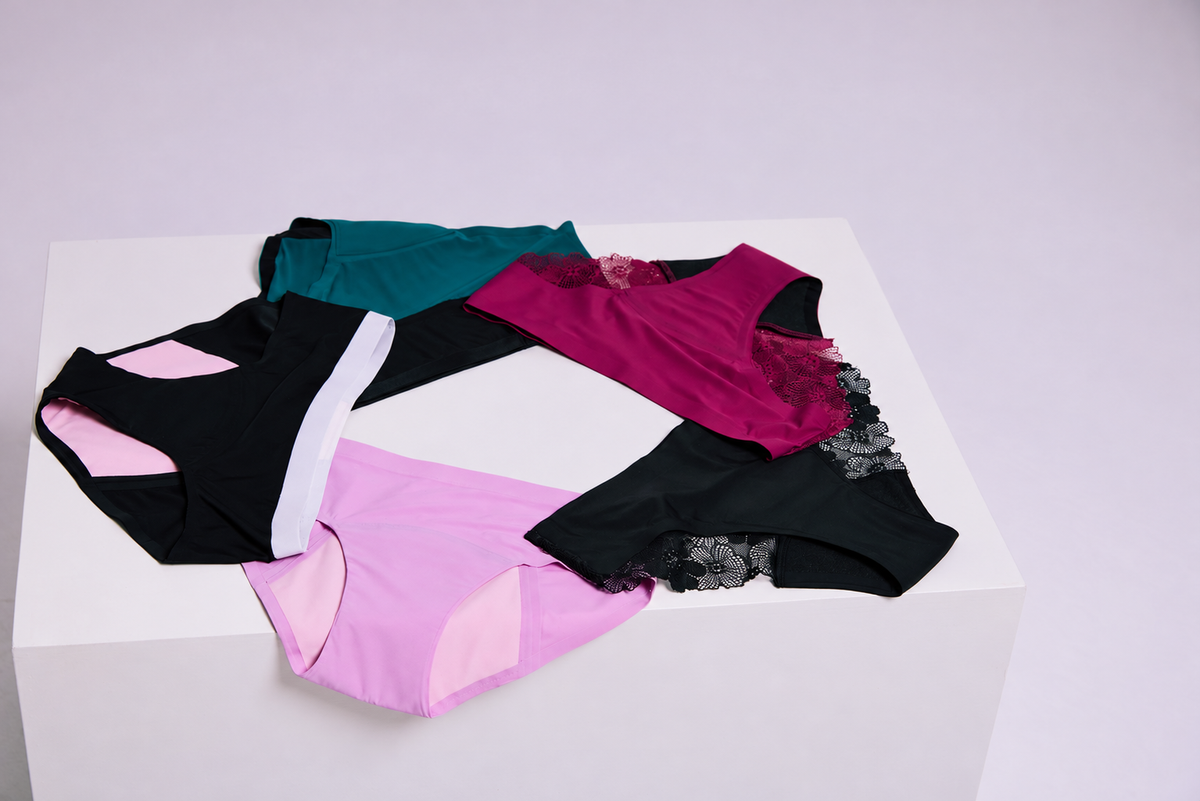

Why do we hide pads and tampons?
We know periods are natural. So why can a visible packet of pads still feel like something that needs explaining?
In a 2022 NPR report from China, university student Wendy Kou challenged a familiar shopping practice: cashiers concealing sanitary pads in black plastic bags. Her response was to propose a transparent bag carrying an anti-shame message.
The practice is easy to question. The pads are clean and wrapped. Why should buying them need a cover?
You may never have been handed a black bag for pads. But perhaps you’ve seen someone tuck one into a sleeve, whisper for a tampon, or take a whole backpack to the bathroom rather than carry a product in her hand. These are different ways of keeping the same thing out of sight.
Yet the same expectation can feel perfectly reasonable elsewhere. A colleague walks to the bathroom with a pad in her hand, and someone wonders why she couldn’t put it in her pocket. Another mentions her cramps, and the conversation becomes awkward. They may agree that periods are natural and still wonder why other people need to know.
We can reject period shame in principle and still expect periods to stay out of sight. What makes concealment feel like ordinary politeness?

Learning what other people should not see
For some people, the rule arrives with their first instructions about period care. In a Philadelphia interview study, a participant remembered her mother explaining how to fold a pad, then adding: “make sure that no one can tell.”
Advice about folding a pad can be practical. In this study, the participant’s recollection appeared among accounts of limited family conversations that left some participants uncomfortable or confused. The researchers interpreted these accounts as signs of generational stigma.
Other lessons are less explicit. Friends lower their voices to ask for supplies. Someone laughs when a pad falls from a bag. An adult changes the subject. You notice who is allowed to hear, then adjust your own behavior accordingly.
A review of qualitative research on menstrual experiences found repeated descriptions of hiding supplies, avoiding conversations and worrying about visible signs of bleeding. Researchers call this “menstrual concealment”: the expectation that nobody should notice you are having a period.
Once learned, it can become automatic. You close your hand around the wrapper before standing up. You take your whole bag to the bathroom. Years later, you may no longer believe the things that made periods embarrassing, but you still know how to keep one hidden.

When discretion becomes a rule
Of course, taking your bag to the bathroom does not mean you feel ashamed. A pouch can keep supplies organized; privacy can simply be your preference. The question is what happens when we expect the same discretion from someone else. There is a practical reason to wrap a used pad and put it in a bin. Carrying a clean pad to the bathroom creates no comparable disposal problem. Treating both as things other people must never see confuses hygiene with secrecy.
“I’d rather keep that private” describes a choice. “Why does she need everyone to know?” suggests that being noticed requires a justification.
A person holding a tampon may just be going to change it. A person mentioning cramps may be explaining why she needs to sit down. Calling those actions a display—or “period pride”—can turn an ordinary need into a statement its owner never intended to make.
And once we agree that the polite thing is to keep quiet, speaking up can feel like breaking a rule, even when there is a good reason to do it.
In interviews with 40 schoolgirls in Northwest Tanzania who had reported menstrual-related absence or early departure, girls described waiting until breaks to change. Asking a teacher for permission could reveal that they were menstruating. Restrictive toilet rules, fear of punishment and worry about stained uniforms made asking harder.
For those girls, staying discreet could mean postponing a change. In a different setting, silence could mean postponing a question: one participant in the Philadelphia study described needing three visits before she felt able to ask a healthcare provider menstrual-related questions because of embarrassment and shame.
These are moments when keeping a period private comes into conflict with getting something you need. A pad can stay out of sight; a need to change it does not go away. A concern about bleeding can remain unspoken; that does not make it less worrying.

Changing the response, not just the person carrying the pad
It would be easy to answer with a confidence lesson: stop worrying, carry the pad, ask the question. But people do not learn this caution in a vacuum.
In a 2002 experiment, a woman working with researchers appeared to accidentally drop either a tampon or a hair clip from her bag. People who saw the tampon judged her as less capable and liked her less than those who saw the hair clip. The ordinary object changed how they saw the person.
That experiment does not tell us how everyone would react today. It does show that a fear of judgment can have a basis in other people’s responses. Making periods easier to discuss requires something from the people listening, too.
A story in a Reddit discussion about visible supplies offers a much warmer response. A woman pulled her wallet from her bag and accidentally scattered several things, including pads, across a checkout counter. She and the male clerk laughed. He asked whether she wanted help gathering the items or would prefer him not to touch them.
He noticed the pads, offered help and left the choice with her. There was no need to pretend they were invisible, and no reason to make her uncomfortable. They could carry on with the transaction.

That kind of response is available to all of us. Offer someone a pad without acting as though it is embarrassing, and let them decide how discreet they want to be. Give a colleague room for a bathroom break without demanding a public explanation. Listen when someone describes a symptom. Keep spare supplies and a bin in the bathroom so people can manage their periods without having to negotiate every step. Schools and workplaces can make bathroom access straightforward, so getting permission does not depend on disclosing a period.
Making periods easier to talk about isn’t excessive pride. We should be able to carry a pad, ask for a bathroom break or explain that we have cramps without feeling embarrassed.
The next time a visible product prompts “Why does she need everyone to know?”, try asking: “Why does she need to make sure nobody knows?”